A neck lift in New Jersey is a surgical procedure that tightens loose platysma muscle, removes or repositions excess fat, and trims sagging skin to restore a defined jawline and neckline. Most patients at Kopelman Aesthetic Surgery invest between $40,000 and $50,000, go home the same day, and see final contours within two to three months.
Neck lift surgery addresses excess fat and muscle laxity that cause the neck to sag. As we age, the platysma muscles weaken, causing a turtle-neck, droopy appearance as skin hangs under the jaw or the front of the neck.
Necklift surgery effectively addresses
this normal aging process. A platysmaplasty procedure tightens and lifts the neck muscles by releasing drooping or banded muscles, then retightening them.
You may also need neck liposuction to shape and remove excess fat or skin. Some people develop excess fat in the pre-platysma or sub-platysma fat pad, which may require liposuction to reduce these deposits and restore natural neck contours.
“Dr. Kopelman, I love my neck and jawline thanks to you. The investment in myself was worth it. I had been so unhappy with my saggy neck and double chin for years. You helped me to restore a sense of confidence in my image! I am so happy I found you on the internet.”
~ Rebecca H. ~
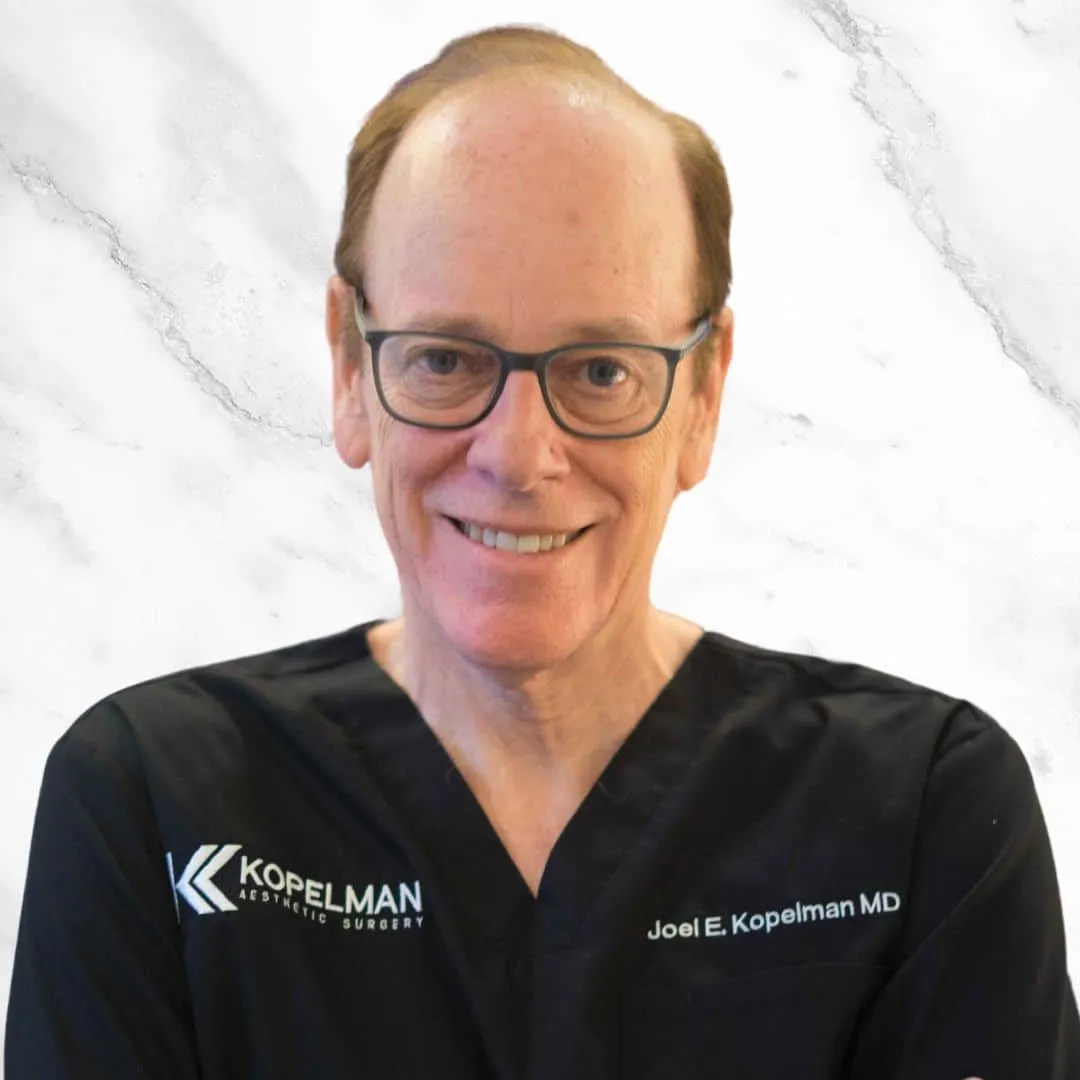
Dr. Joel E. Kopelman is a facial plastic and oculoplastic surgeon with more than 35 years of experience in cosmetic rejuvenation of the face, neck, and eyes. That dual training matters for necklift work because you must assess the transition between the lower eyelid, midface, and jawline as a single aging pattern rather than in isolation.
His approach to a necklift in NJ involves tightening the deeper tissues beneath the platysma muscle. By securing the neck muscles both laterally and at the midline, the surgeon can restore your original youthful neck position.
Avoiding visible scarring is a defining priority of the technique. This is accomplished by making two small incisions, one below the chin and the other behind the ear, both of which settle into natural creases over several months.
The practice is located at 1 W Ridgewood Ave in Paramus, Bergen County, and treats patients traveling from Hackensack, Ridgewood, Fort Lee, Montclair, and Morris County, as well as those seeking a neck lift in South Jersey who prefer to consolidate consultation and surgery into a single trip north.
Ideal Necklift Candidate
Necklift Benefits
Necklift Techniques
Sometimes the neck ages faster than the rest of the face. In these cases a targeted procedure will do the trick.
Not every aging neck needs the same procedure, and matching the technique to the tissue separates a natural result from an overcorrected one. The decision rests on three variables: how much the platysma has separated, how much fat sits above and below that muscle, and how much elasticity the skin has left.
Platysmaplasty addresses the muscle itself. When the paired platysma muscles separate at the midline with age, they create the vertical bands many patients describe as cords or a turkey neck. Releasing and re-approximating those edges restores the underlying sling that gives the neck its shape.
Neck liposuction in New Jersey addresses volume, not laxity. It works well for younger patients with strong skin tone and isolated submental fullness, but liposuction alone will disappoint anyone whose skin has already lost its ability to retract.
Combined platysmaplasty with liposuction is the most common approach in patients over fifty, because muscle separation and fat accumulation typically progress together. The American Society of Plastic Surgeons notes that fat may be sculpted, removed, or redistributed while the underlying tissue is repositioned and the platysma tightened, which reflects how these components are addressed in a single operation. ASPS, Neck Lift Procedure Steps.
| Technique | Best Suited For | What It Corrects | Incisions | Return to Work |
|---|---|---|---|---|
| Neck liposuction | Ages 30 to 45 with good skin elasticity | Submental fat only; no muscle or skin correction | One small incision below the chin | About 7 days |
| Platysmaplasty | Visible vertical banding with minimal excess fat | Separated platysma muscle; restores neck angle | Below the chin, often with a small incision behind the ear | 10 to 14 days |
| Platysmaplasty with liposuction | Ages 50 and above with combined fat and muscle laxity | Fat, muscle separation, and excess skin together | Below the chin and behind both ears | 10 to 14 days |
| Facelift with neck rejuvenation | Jowling and midface volume loss alongside neck laxity | Full lower face, jawline, and neck as one unit | Around the ear extending into the hairline | 2 to 3 weeks |
Surgical fees vary based on the extent of the operation, whether liposuction is included, and whether the procedure is combined with facial rejuvenation under the same anesthesia. The figures below reflect current pricing at Kopelman Aesthetic Surgery.
We confirm every surgical estimate in writing after an in-person evaluation, since we cannot determine the technique from photographs alone. We apply consultation fees toward the cost of surgery when patients proceed.
| Procedure | Cost | Notes |
|---|---|---|
| Necklift (platysmaplasty) | $40,000 to $50,000 | Range reflects extent of muscle tightening and skin removal |
| Neck liposuction alone | Quoted at consultation | Suitable only when skin elasticity is well preserved |
| Deep plane facelift | $45,000 to $60,000 | Addresses midface, jawline, and neck in one operation |
| Upper blepharoplasty | $10,000 | Frequently combined under the same anesthesia |
| Lower blepharoplasty | $10,000 | Frequently combined under the same anesthesia |
| Botox for vertical neck bands | $1,200 to $1,800 | Priced per session, not per unit |
| Surgical consultation | $350 | Applied toward the cost of surgery |
After your neck lift procedure, you can go home the same day. Whether you had platysmaplasty or liposuction, expect mild discomfort, swelling, and bruising for the next 2 weeks.
After surgery, we will apply a compressive elastic strap around your neck to help reduce swelling and speed recovery. Dr. Kopelman is always available to patients as they recover, and he will often see you through the first few weeks.
You will achieve your final results within 2 to 3 months. Throughout recovery, we will guide you on how to maximize your outcome by discussing all components of the healing process.
A drain placed during surgery is typically removed within 24 to 48 hours, and sutures come out at 5 to 7 days. Most patients resume daily activities within a week, return to exercise at about two weeks, and return to work roughly 10 to 14 days after surgery. Residual swelling that resolves gradually over several weeks is expected and normal. ASPS, Neck Lift Recovery.
The neck does not age independently of the face, and patients who address only one region sometimes find the untreated area now looks comparatively older. During your evaluation, we assess adjacent concerns so you can decide how comprehensive you want the result to be.
Facelift or deep plane facelift. When jowling, midface volume loss, and neck laxity appear together, a facelift addresses all three from a single set of incisions. An isolated neck procedure is the better choice when the upper and middle face still look rested.
Eyelid surgery and brow lift. Upper facial aging is frequently the first thing others notice. Blepharoplasty and endoscopic brow lifting are commonly performed alongside neck surgery under the same anesthesia.
Fat grafting and laser skin rejuvenation. Tightening the platysma restores structure but does not improve skin texture, sun damage, or crepiness. Resurfacing and volume restoration address surface quality that surgery cannot.
Nonsurgical options. Neuromodulators can soften vertical banding, and injectable treatments can address volume loss, though neither removes skin or repairs a separated platysma. ASPS notes that nonsurgical rejuvenation may delay when surgery becomes appropriate, but cannot achieve the same result. ASPS, Neck Lift.
Credentialing is the most useful filter when comparing surgeons, and patients often skip it. ASPS advises verifying board certification, choosing a surgeon who operates from an accredited facility, and selecting a surgeon near where you will spend your recovery, since follow-up during the healing months carries real value.
When evaluating any platysmaplasty surgeon, ask three questions: how many necklift procedures they perform annually, whether they will show you before and after cases matching your specific anatomy, and who manages your care if a complication arises after hours.
Dr. Kopelman will review your medical history as well as the prescription and non-prescription medications you may be taking. You must stop all blood thinners (such as aspirin, Motrin, fish oil and Vitamin E) at least two weeks prior to surgery to minimize the potential for bleeding, post-operative bruising and swelling.In addition, if you smoke you must refrain from smoking for two weeks prior to surgery because it may compromise your ability to heal and increase the chances that you will develop scars.
A neck lift is usually performed under local anesthesia with intravenous “twilight’”sedation. The procedure takes approximately three hours. The goal of a neck lift is to elevate and tighten sagging soft tissue through short incisions. Fat below your chin and neck will be re-contoured, underlying sagging muscle will be repositioned and tightened and excess skin will be trimmed behind your ear. The incisions will be hidden within your natural creases below your chin and behind your ears so that over several months these incisions will become inconspicuous.
Following the neck lift procedure, a gauze dressing will be applied under your chin and behind your ears. These dressings will be removed the next day. A drain that was inserted during the procedure will be removed in most cases within 24 to 48 hours after surgery. Most patients typically experience little or no discomfort, but if there is any, it is easily controlled with over-the-counter pain medication. You will be examined by Dr. Kopelman and his nursing staff the next morning. Sutures will be removed in 5 to 7 days following the neck lift surgery. You can resume your daily activities within one week and your exercise routine within two weeks.Incisional scars will be hidden in the natural creases of your face and ears and in time they will be barely visible. To ensure that you have the best possible results Dr. Kopelman will examine you at regularly scheduled intervals to monitor your progress. Most patients return to work about 10 to 14 days after the neck lift surgery.
Sometimes it is not necessary to have a more extensive “full” facelift because most of your facial cosmetic concerns revolve around loose neck skin, sagging neck muscles and bulging fat. Many patients do not show a significant loss of mid-facial fullness or the descent of upper facial soft tissue. Therefore, a more limited procedure, a limited neck lift, is a good alternative to having a traditional full facelift. Neck lifts can be performed with shorter incisions which can restore smooth contours to your neck. On the other hand, a “full” facelift , a more extensive procedure, is the ideal treatment option for patients with moderate to severe signs of aging including jowls,extensive muscle and skin laxity, and mid-facial volume loss. At the time of your initial consultation Dr. Kopelman will review your unique characteristics and concerns. You will have an opportunity to discuss your goals and expectations and ask any relevant questions you may have. Dr. Kopelman will determine if you are an ideal candidate for an isolated neck lift or for a traditional facelift.
Yes, depending upon your cosmetic concerns, Dr. Kopelman may recommend other complimentary cosmetic procedures such as cosmetic eyelid surgery (blepharoplasty), fat grafting, endoscopic brow lifts, and laser skin rejuvenation to enhance the overall appearance of your face.
We will review your medical history and any prescription and non-prescription medications you may be taking. You must stop all blood thinners, such as aspirin, Motrin, fish oil, and Vitamin E, at least two weeks before surgery to minimize the risk of bleeding, post-operative bruising, and swelling.
In addition, if you smoke, you must refrain from smoking for two weeks prior to surgery, because it may compromise your ability to heal and increase the chances that you will develop scars.
The procedure is usually performed under local anesthesia with intravenous twilight sedation and takes approximately three hours. The goal is to elevate and tighten sagging soft tissue through short incisions.
Fat below your chin and neck will be re-contoured, underlying sagging muscle will be repositioned and tightened, and excess skin will be trimmed behind your ear. The incisions will be hidden within your natural creases below your chin and behind your ears so that, over several months, they become inconspicuous.
After surgery, we apply a gauze dressing under your chin and behind your ears and remove it the next day. In most cases, we remove the drain inserted during the procedure within 24 to 48 hours. Most patients typically experience little or no discomfort, but if there is any, it is easily controlled with over-the-counter pain medication. Dr. Kopelman and his nursing staff will examine you the next morning. Sutures are removed in 5 to 7 days.
You can resume your daily activities within one week and your exercise routine within two weeks. Incisional scars will be hidden in the natural creases of your face and ears, and in time they will be barely visible. To ensure the best possible results, we will examine you at regularly scheduled intervals to monitor your progress. Most patients return to work about 10 to 14 days after surgery.
Sometimes a more extensive full facelift isn’t necessary because most facial cosmetic concerns involve loose neck skin, sagging neck muscles, and bulging fat. Many patients don’t show significant loss of mid-facial fullness or descent of upper facial soft tissue. Therefore, a more limited procedure is a good alternative to a traditional full facelift and can be performed with shorter incisions that restore smooth contours.
On the other hand, a full facelift is the ideal treatment option for patients with moderate to severe signs of aging including jowls, extensive muscle and skin laxity, and mid-facial volume loss.
At your initial consultation, we will review your unique characteristics and concerns, and you will have an opportunity to discuss your goals and expectations and ask any relevant questions. At that time, we will determine whether you are a candidate for an isolated procedure or a traditional facelift.
Yes. Depending on your cosmetic concerns, we may recommend complementary procedures, such as cosmetic eyelid surgery (blepharoplasty), fat grafting, endoscopic brow lifts, and laser skin rejuvenation, to enhance your overall facial appearance.
Surgical fees at the practice range from $40,000 to $50,000, depending on whether liposuction is included and whether the procedure is combined with other facial surgery. The practice provides a written estimate after an in-person evaluation. The practice does not offer payment plans.
Tightening the platysma produces structural change that holds for many years. Aging continues from a new starting point rather than reversing entirely, so most patients find their neck looks younger than it would have without surgery, often for well over a decade.
Liposuction alone suits patients whose primary issue is submental fullness and whose skin still retracts well, typically those in their thirties and forties. If vertical banding or loose skin is present, removing fat without addressing the muscle and skin envelope tends to make laxity more visible, not less.
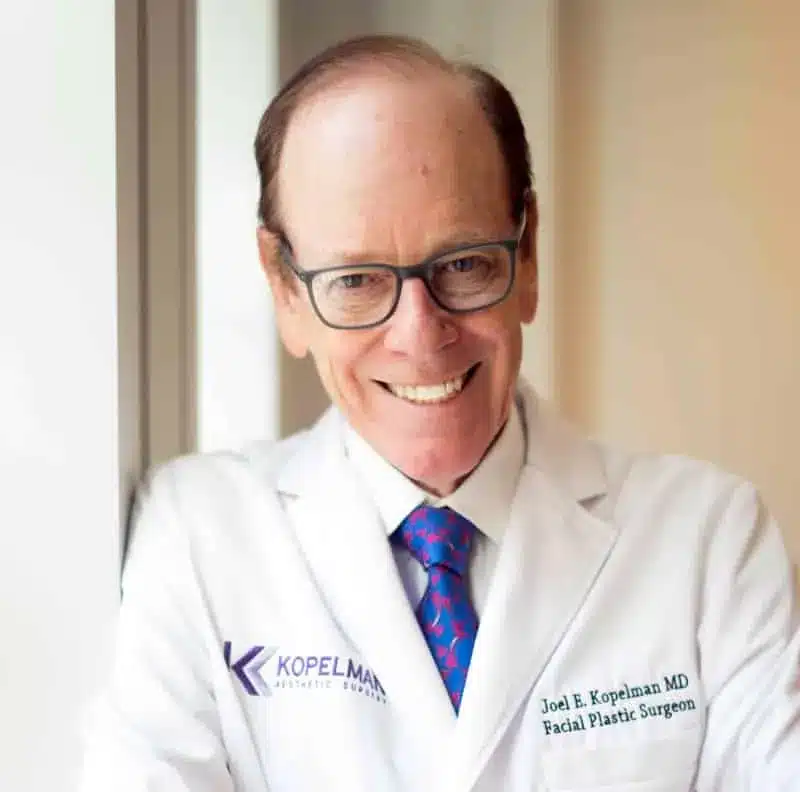
To schedule a private consultation with Dr. Kopelman,
please call the office or request an appointment online.
















Lorem ipsum dolor sit amet, consectetur adipiscing elit. Ut elit tellus, luctus nec ullamcorper mattis, pulvinar dapibus leo.