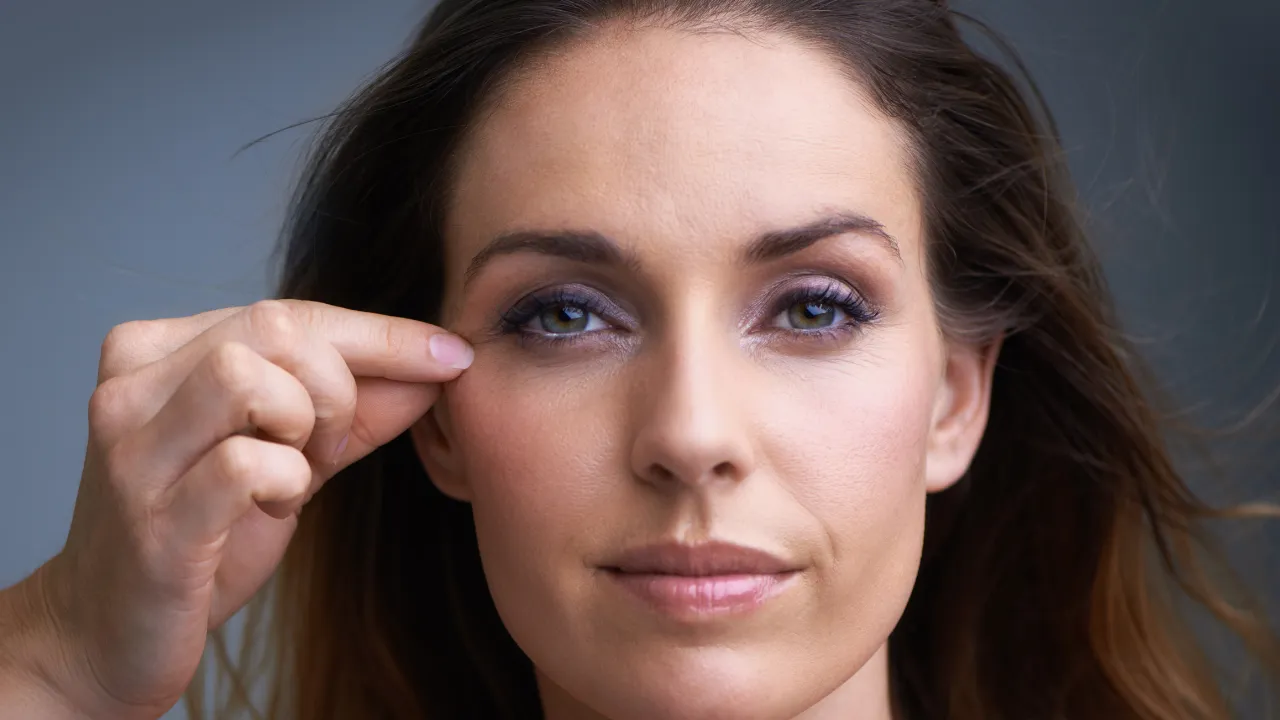
Ptosis Surgery Miami Florida: Droopy Eyelid Treatment FL

Ptosis repair in Miami is a surgical procedure that lifts a drooping upper eyelid by tightening or reattaching the muscle that raises the eyelid. It restores upper field of vision when the eyelid hangs low enough to block sight, and it opens the eye for a more balanced, rested look.

Eyelid ptosis surgery in Miami is typically an outpatient procedure performed under local anesthesia with light sedation. Most patients go home the same day, and sutures come out within a week.

Ptosis can develop with age, be present at birth, or follow trauma, neurological conditions, cataract surgery, or years of hard contact lens wear. Board-certified facial plastic and oculoplastic surgeon Dr. Joel Kopelman evaluates eyelid height, levator muscle function, vision symptoms, and upper eyelid skin before recommending a droopy eyelid treatment plan.

The disinsertion of muscle attachments that leads to ptosis occurs most often as an age-related change; it can also occur at birth and in middle-aged patients who have worn hard contact lenses for long periods. Like an overhanging awning, this downward droop obstructs the superior field of vision.

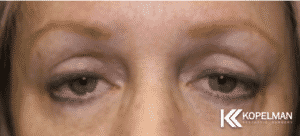
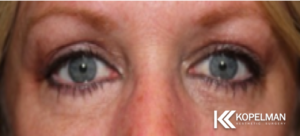
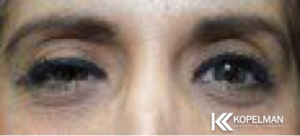
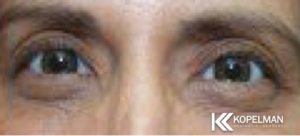
Ptosis Surgery in Miami: Before & After

These Ptosis before and after pictures represent actual patients from Dr. Kopelman. They will help you to set realistic goals for your own surgical outcome. Click on a patient to learn more about their Ptosis surgery.

“I first met Dr. Kopelman when I was diagnosed with a condition called Ptosis, which causes dropping eyelids. He performed surgery to correct the problem, and the results were outstanding. Dr. Kopelman is a caring, kind physician who treats his patients with respect. In addition, I can’t imagine finding a more skilled doctor.”  

~ Gwen McCarthy ~

Eyelid Ptosis Repair Miami: Surgical Techniques

There is no single approach to eyelid droop repair in Miami. The right technique depends on how far the lid sits below its normal position and how much lifting strength the levator muscle still has.

Two internal muscle groups raise the upper eyelid: the levator and Mueller’s muscle. Mild to moderate droop is usually corrected by tightening the posterior Mueller’s muscle. When a greater degree of ptosis is present, tightening the anterior levator muscle is preferred.

In rare cases where the lifting muscle has almost no function, a frontalis suspension approach connects the eyelid to the forehead muscle so the brow can assist lid elevation. Your surgeon confirms which method applies after measuring lid height and levator excursion at consultation.

Ptosis repair techniques compared
Technique Best suited for Incision location Visible scar Anesthesia
Conjunctival-Mueller's muscle resection (internal) Mild to moderate droop with good muscle function Inside surface of the eyelid None Twilight sedation with local anesthesia
Levator muscle resection (external) Moderate to significant droop Natural upper eyelid crease Hidden in the crease, fades over time Light sedation with local anesthesia, patient participates
Frontalis suspension Very weak or absent levator function, including some congenital cases Upper eyelid and brow Small, positioned within natural contours Determined case by case

Dr. Kopelman's approach to ptosis repair will help you restore your vision and will create a more youthful appearance to your face

Ptosis Surgery Miami: Procedure

Internal ptosis repair is corrected by tightening the internal eyelid muscles that open the lids. Most mild to moderate degrees of eyelid droop can be corrected through the posterior Mueller’s muscle. Greater degrees of droop are addressed through the anterior levator muscle.

If the posterior Mueller’s muscle is tightened, the patient can be in a twilight sleep, and no cooperation is necessary. However, greater degrees of ptosis require levator muscle surgery, during which the patient opens and closes the eyelids.

To precisely titrate the degree of elevation and restore eyelid contour, the patient must be able to raise the lids during the operation. Because the patient takes an active role, only light sedation with local anesthesia is used. Surgery is performed on an outpatient basis, and you return home the same day with a driver.

Am I a Candidate for Ptosis Repair in Miami?

You may be a candidate for droopy eyelids surgery in Miami if the upper lid margin rests low enough to shadow or block your vision, if you lift your brow or tilt your head back to see, or if one eye looks noticeably smaller than the other.

Eyestrain, brow fatigue by late afternoon, and headaches from constant forehead lifting are also common reasons patients seek eyelid droop repair in Miami.

Sudden or rapidly progressive droop is different. New-onset ptosis can signal a neurological or systemic condition such as myasthenia gravis, third nerve palsy, or Horner’s syndrome, so it must be evaluated by a physician trained in eyelid and orbital disease before any surgery is scheduled.

Good candidates typically:

  • Have a measurable upper eyelid droop confirmed on examination
  • Are in good general health with well-controlled medical conditions
  • Do not smoke, or are willing to stop before and after surgery
  • Have realistic expectations about symmetry, since perfect matching is not always achievable
  • Have any dry eye, thyroid eye disease, or corneal concerns assessed first

Benefits of eyelid ptosis surgery:

  • Restored upper field of vision
  • Reduced brow strain, eye fatigue, and forehead tension
  • A more open, alert, and rested eyelid appearance
  • Improved eyelid contour and symmetry
  • Long-lasting results from a single outpatient procedure

Recovery from Ptosis & Droopy Eyelid Treatments

Swelling and minor bruising are expected after eyelid ptosis repair. Swelling is minimized early on by frequent application of ice compresses using zip-lock bags. After two days of ice, switch to warm compresses, which help accelerate resolution of bruising.

Discomfort is typically minimal and is commonly controlled with plain Tylenol. Sutures are removed 5 to 7 days after surgery. Avoid strenuous activity, heavy lifting, and swimming for about 2 weeks, and protect the area from sun exposure while it heals.

Typical ptosis repair recovery timeline
Time after surgery What to expect Care and activity
Days 1 to 2 Peak swelling and bruising, mild tightness Ice compresses frequently, head elevated, rest at home
Days 3 to 5 Swelling begins to settle, bruising starts to fade Switch to warm compresses, light activity around the house
Days 5 to 7 Sutures removed at a follow-up visit Many patients return to desk work and social activity
Weeks 2 to 3 Most visible bruising resolved, contour becoming apparent Gradual return to exercise once cleared
Weeks 4 to 6 Residual swelling continues to refine, lid height settles Normal routine, continued sun protection
Months 3 to 6 Final eyelid position and incision maturation Routine follow-up as recommended

When Will I See Results, and Are They Permanent?

A lifted eyelid position is visible immediately after surgery, though early swelling makes the result look fuller than the final outcome. Most patients see the shape they will keep at around 4 to 6 weeks, with subtle refinement continuing for several months.

Results of ptosis surgery in Miami are generally long-lasting and, for most patients, effectively permanent. The repaired muscle attachment is designed to hold, and the correction does not simply reverse over a short period.

Aging continues, however. The levator attachment can stretch again over many years, and a small percentage of patients need a revision or minor adjustment to fine-tune lid height or symmetry, particularly after complex or congenital cases.

Combining Ptosis Repair With Other Eyelid Procedures

Eyelid droop is often accompanied by excess upper eyelid skin, which is a separate problem requiring a separate solution. An upper eyelid blepharoplasty removes redundant skin and protruding fat, while ptosis repair addresses the muscle that lifts the lid.

When both are present, muscle repair and skin removal are commonly performed in the same operation to achieve optimal rejuvenation. Identifying underlying ptosis before eyelid surgery matters, because correcting skin alone can leave the eye still looking tired.

Patients interested in a fox-eye lift in Miami often ask whether it can be combined with ptosis correction. A lateral canthoplasty, the procedure behind the fox-eye look, adjusts the outer corner position and can be planned alongside eyelid ptosis surgery in Miami when the anatomy allows.

Brow position is also assessed. If the brow is doing the lifting, a brow lift may be recommended instead of, or alongside, eyelid ptosis repair in Miami, so the correction holds without excessive forehead effort.

How Much Does Ptosis Repair Cost in Miami?

Ptosis surgery pricing depends on whether one or both eyes are treated, which technique is used, and whether the procedure is combined with eyelid or brow surgery. Facility and anesthesia fees are quoted separately.

Ptosis and related eyelid procedure pricing
Procedure Price Notes
Ptosis repair $10,000 per eye Technique selected based on levator function and degree of droop
Upper eyelid blepharoplasty $8,500 Addresses excess skin and fat, often combined with ptosis repair
Lateral canthoplasty (fox eye lift) $7,500 to $8,500 Outer corner repositioning, planned case by case
Ptosis repair combined with blepharoplasty Quoted at consultation Combined pricing depends on the surgical plan
Frontalis suspension Quoted at consultation Reserved for minimal levator function
Consultation $350 Includes eyelid measurement and evaluation

Is ptosis repair covered by insurance?

Because a drooped eyelid impairs vision and can impede daily activities, it is viewed as a functional impairment, and your insurance carrier may cover the procedure. Coverage generally depends on documented visual field testing and photographs.

Eyelid ptosis must be differentiated from excessive laxity of upper eyelid skin. When skin hangs down and fat bulges appear, an upper eyelid blepharoplasty is needed to remove excess skin and protruding fat, and that cosmetic component is not covered by medical insurance.

At your visit, a comprehensive evaluation determines whether ptosis is present alone or alongside lax skin and bulging fat. If both muscle and skin laxity are present, repair and cosmetic correction can be performed simultaneously to achieve an optimally rejuvenated appearance.

Best Doctor for Ptosis Surgery in Florida: Dr. Joel Kopelman

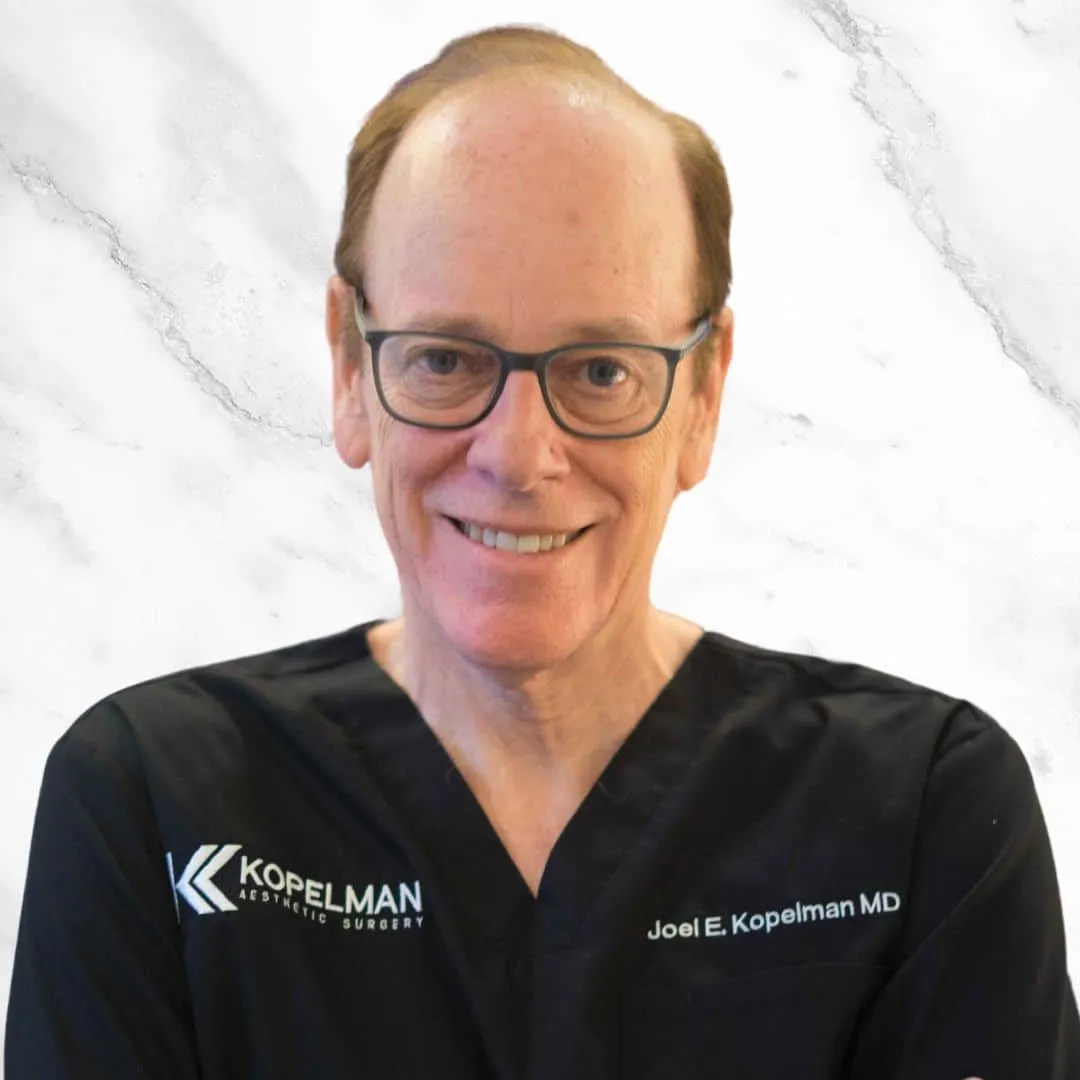
Dr. Joel E. Kopelman is a facial plastic and oculoplastic surgeon with over 35 years of experience in cosmetic rejuvenation of the face, neck, and eyes. He sees patients at offices in New York City, New Jersey, and Florida.

This dual background matters for eyelid work. Oculoplastic training centers on the eyelids, orbit, and tear system, which is why functional problems like eyelid droop and cosmetic goals can be assessed together rather than separately.

He has performed hundreds of cosmetic and reconstructive eyelid procedures, published numerous articles on eyelid surgery, and continues to be sought out by colleagues and patients across the East Coast for his expertise in blepharoplasty.

Every patient presents with a unique set of characteristics, both in anatomy and in the degree of laxity of surrounding tissue. That extensive oculoplastic experience allows your eyelid condition to be assessed for both functional and cosmetic improvement.

The practice is affiliated with the American Academy of Ophthalmology and the American Society of Ophthalmic Plastic and Reconstructive Surgery, the specialty society for surgeons focused on the eyelids and orbit.

Ideal Ptosis Candidate

  • Upper eyelid margin resting low enough to shadow vision
  • Habitual brow lifting or head tilting to see clearly
  • Eyelid asymmetry, with one eye appearing smaller

Ptosis Benefits

  • Restored upper field of vision
  • Reduced brow and forehead strain
  • More open, alert eyelid appearance

Ptosis Techniques

  • Conjunctival-Mueller’s muscle resection
  • Levator muscle resection
  • Frontalis suspension for minimal levator function

Our approach to ptosis repair is designed to restore your vision while creating a more youthful appearance to your face.

Frequently asked questions
about Ptosis

Because the drooped eyelids impairs your vision and can impede your daily activities it is “viewed” as a functional impairment. Your insurance carrier may cover the procedure. However, eyelid ptosis must be differentiated from excessive laxity of upper eyelid skin. 

An eyelid droop must be differentiated from a laxity of the upper eyelid skin that can hang down and impinge on your field of vision. When skin hangs down and fat bulges appear then an upper eyelid blepharoplasty, a cosmetic procedure, is necessary to remove excess skin and protruding fat. At the time of your visit, Dr. Kopelman will perform a comprehensive evaluation of your drooped eyelids. He will determine if ptosis (drooped upper lid) is present alone or whether it exists concurrently with lax upper eyelid skin and bulging fat. If both eyelid muscle and skin laxity exist together then a ptosis repair and cosmetic procedure can be performed at the same time in order to achieve an optimal rejuvenated appearance. Unfortunately, the cosmetic component is not covered by your medical insurance.

Frequently asked questions
about Ptosis
Dr. Joel E. Kopelman is a both a facial plastic and oculoplastic surgeon with over 35 years of experience in cosmetic rejuvenation of the face, neck, and eyes. Renowned for his innovative techniques and meticulous approach, Dr. Kopelman has built a reputation as a trusted expert among patients seeking transformative results that are both beautiful and natural.
Dr. Kopelman’s commitment to excellence extends beyond surgery; his warm and compassionate approach provides patients with a sense of comfort and trust throughout their treatment journey. Supported by a team of first-class professionals, Dr. Kopelman continuously strives to exceed patient expectations, fostering a reputation for delivering unparalleled satisfaction and long-lasting results.
Page Updated on [last_updated_date] by Dr. Joel Kopelman (Facial Plastic Surgeon) of Kopelman Aesthetic Surgery.

Schedule a Consultation

For Ptosis Eyelid Surgery

To schedule a private consultation with Dr. Kopelman, please call the office or request an appointment online.

Add Your Heading Text Here

Lorem ipsum dolor sit amet, consectetur adipiscing elit. Ut elit tellus, luctus nec ullamcorper mattis, pulvinar dapibus leo.