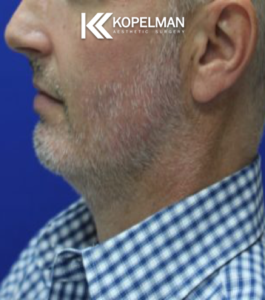
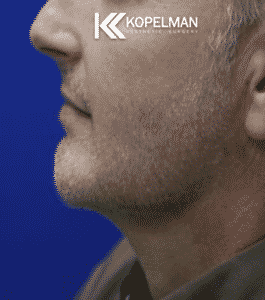
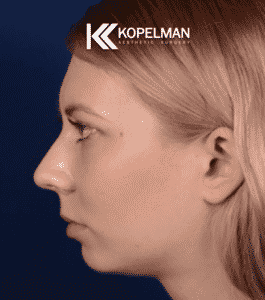
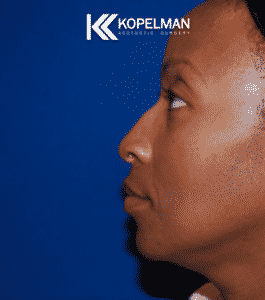
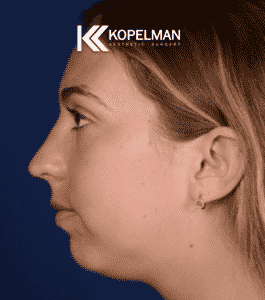
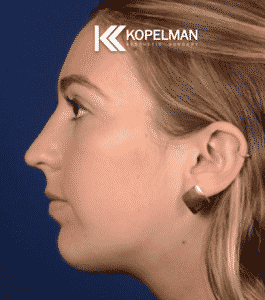
Chin augmentation is a surgical procedure in which an implant is placed through a small incision beneath the jawline to improve the projection of a recessed or underdeveloped chin. Some people have a “weak” chin relative to their other facial features. A small chin may sometimes make a person appear to have a large, over-projected nose in profile.
The objective of a chin implant is to help restore facial balance and harmony in people with receding chins relative to other facial features. The implant lengthens your vertical frontal facial dimensions and improves the horizontal contour of your profile.
Usually, a solid silicone implant is inserted through a small incision below the jawline. Alternatively, you can use a non-surgical, non-permanent approach to enhance projection by injecting hyaluronic facial fillers (like Juvederm).
Fillers allow you to see the difference in your contour immediately with no downtime, but the improvement lasts only months. Facial implants are a permanent solution that helps restore balance and harmony across the lower face.
| Detail | What to expect |
|---|---|
| Procedure type | Outpatient surgical augmentation with a solid silicone implant |
| Anesthesia | Local anesthesia with sedation, or general anesthesia |
| Incision | Submental (under the jaw) or intraoral (inside the lower lip) |
| Sutures removed | Day 5, followed by steri-strips for three days |
| Return to routine activity | Typically within the first week |
| Final result visible | Approximately six weeks |
| Longevity | Permanent; no replacement required |
| Surgical fee | Quoted at consultation |


“I have been eager for a long time to improve my profile. I always felt that I had a recession in my chin. Dr. Kopelman helped create the facial balance and symmetry I hoped for. I am super happy with my outcome and the projection of my chin, which now looks and feels natural. I’m excited when I look in the mirror, especially when I put on makeup to head out with friends. If you are looking for an honest plastic surgeon who will deliver the highest quality of work, Dr. Kopelman is your best bet.”
~ Rebecca Klein ~
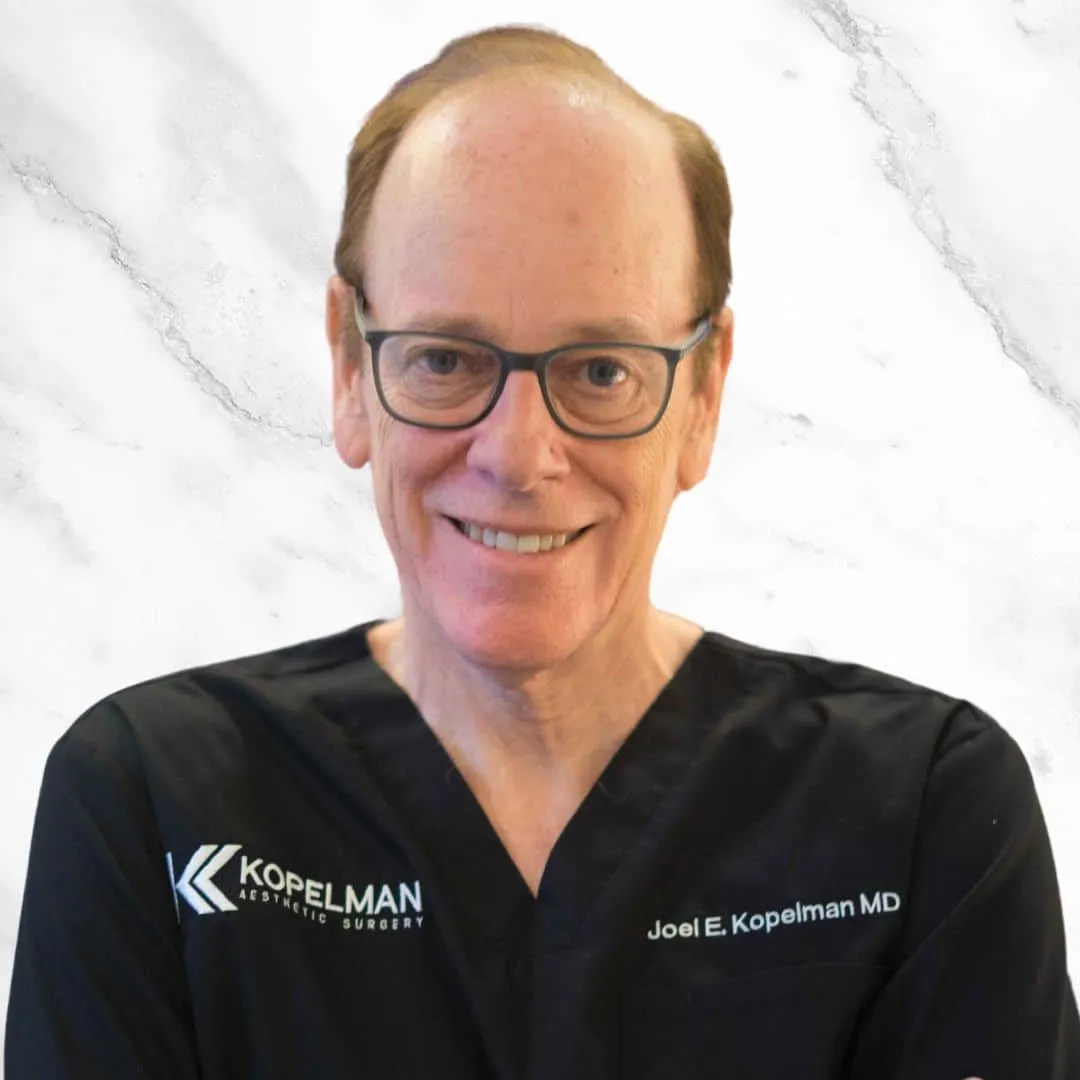
To achieve the best chin augmentation in New Jersey, Dr. Kopelman thoroughly reviews your facial skin, soft tissues, and skeletal structure, then discusses your desires and expectations for surgery.
He determines whether you have a weak or receding profile by examining your upper and lower jaw, which allows him to select the size and type of implant needed to achieve optimal aesthetic results.
Facial implants come in many shapes and sizes and are made from both solid and semi-solid materials. Finding the right fit is critical to achieving great results.
As a facial plastic and oculoplastic surgeon, Dr. Kopelman evaluates the lower face in relation to the eyes, nose, and neck rather than in isolation, which is central to a natural profile.
Ideal Candidate
Benefits
Chin Augmentation Techniques
Chin augmentation will balance your frontal and profile facial proportions.
Dr. Joel Kopelman performs chin augmentation through a small incision along the natural crease under the chin.
The implant is inserted through this incision and positioned along the jawline. The incision is closed with tiny sutures and is well camouflaged, making it almost invisible.
The implant sits directly on the bone within a precisely made pocket, holding it in place and preventing shifting over time. Placement is an outpatient procedure, and most patients return home the same day.
According to the American Society of Plastic Surgeons, augmentation of an under-projected chin typically involves placing an implant directly on the bone through an incision inside the mouth or beneath the skin.
The cost of chin surgery in NJ depends on several factors: whether the procedure is performed alone or combined with another surgery, the type of anesthesia used, and the surgical facility.
Because this type of facial augmentation is elective and cosmetic, insurance generally does not cover it. Dr. Kopelman reviews the full fee with you during your private consultation, after examining your anatomy and confirming which implant suits your goals.
Non-surgical alternatives are priced per session rather than per unit, and the figures below reflect current practice pricing.
| Option | Cost | Notes |
|---|---|---|
| Chin augmentation surgery (implant) | Quoted at consultation | Fee confirmed after examination and implant selection |
| Juvederm Voluma | $1,800 | Priced per session, not per unit or syringe |
| Juvederm Ultra | $1,800 | Priced per session |
| Restylane | $2,500 | Priced per session |
Not everyone needs surgery. For patients who want to preview a stronger profile before committing, hyaluronic acid gels can add projection immediately with no downtime.
The trade-off is duration. Injectables are temporary and require repeat sessions to maintain, while a facial implant is a one-time, permanent structural change.
Some patients whose main concern is fullness beneath the jawline, rather than a lack of projection, are better served by neck contouring than by augmentation. Dr. Kopelman evaluates bone structure and soft tissue volume together to determine the best approach.
| Factor | Facial implant | Hyaluronic acid filler |
|---|---|---|
| Duration | Permanent | Months; requires repeat sessions |
| Result visible | Settles over about six weeks | Immediately |
| Downtime | Approximately one week | None |
| Reversibility | Implant can be removed or exchanged | Can be dissolved |
| Degree of projection | Greater structural change | Moderate, volume-based change |
| Best suited to | Patients committed to a permanent correction | Patients previewing a change before surgery |
Augmentation of the lower face is frequently planned alongside another procedure, because the profile is shaped by several structures at once.
Rhinoplasty. The nose and the lower face are optically linked, so strengthening projection often makes the nose appear more proportionate on profile view.
Neck and jawline liposuction. Removing fullness beneath the jaw sharpens the transition between the neck and lower face, amplifying the implant’s effect.
Facelift. Adding structure to the lower face during facial rejuvenation restores definition that soft tissue lifting alone cannot create.
Facial volume restoration. Fat grafting or hyaluronic acid gels can supplement volume along the jawline and cheeks in the same treatment plan.
Planning these together means a single recovery period rather than several. Dr. Kopelman determines the appropriate combination during consultation.
Recovery is straightforward for most patients. The schedule below reflects the typical first week after surgery.
| Day | What to do | What to expect |
|---|---|---|
| Day 1 | Keep the dressing in place; apply cold compresses; Tylenol every 4 to 6 hours while awake | Swelling and possible bruising begin |
| Day 2 | Remove the dressing; continue cold compresses | Swelling begins to subside |
| Day 3 | Switch to warm compresses; apply topical antibiotic cream to the incision four times a day | Swelling and possible bruising still present; less Tylenol needed |
| Day 4 | Continue antibiotic cream four times a day to the incision | Swelling starting to resolve; less and less discomfort |
| Day 5 | Sutures removed and steri-strips applied; leave steri-strips in place for three more days | Contour becomes easier to assess |
Beyond the first week, most swelling resolves over the next two to three weeks. The implant continues to settle, and the final contour becomes fully apparent at roughly six weeks.
You can generally resume strenuous exercise and contact sports later than routine daily activity. Dr. Kopelman provides your individual clearance schedule at your follow-up visit.
Dr. Kopelman will photograph and measure your chin and jawline to select the ideal implant size that harmoniously balances your profile and frontal dimensions. If a patient is not yet ready for chin augmentation surgery, Dr. Kopelman may recommend temporary chin filler.
Hyaluronic acid gels like Juvederm, Voluma, or Restylane Lyft are safe, natural, non-surgical alternatives to chin implant surgery. These temporary injections can give a patient a realistic vision of what a more balanced facial profile may look like. This temporary measure gives a patient time to decide whether they like the change before committing to a permanent surgical procedure.
A chin implant can be a stand-alone procedure or scheduled with another surgery, such as nose-shaping, liposuction of the neck and jawline, or a facelift.
We quote surgical fees at consultation, once Dr. Kopelman has examined your anatomy and confirmed the appropriate implant and technique. We price non-surgical enhancement with hyaluronic acid gel per session, not per unit or syringe.
Solid silicone has one of the longest safety records in facial plastic surgery. Unlike a fluid-filled device, a solid implant cannot rupture or leak. It rests in a pocket over the bone, and surrounding tissue settles around it over time.
When the implant is correctly sized and positioned, it is indistinguishable from a naturally well-defined jawline. Sizing is the decisive factor, which is why Dr. Kopelman measures and photographs before selecting the implant.
When placed through the submental approach, the incision sits within the natural crease beneath the jaw and becomes very difficult to see once healed. With an intraoral placement, there is no external scar.
Solid implants do not dissolve and do not require replacement. Because the implant sits within a defined pocket rather than bonded to bone, it can be removed or exchanged if a patient’s preferences change.
Candidates should have completed facial growth, be in good general health, and hold realistic expectations. There is no upper age limit; suitability depends on health status, not age alone. MedlinePlus provides a general overview of how the procedure reshapes or enhances the size of the chin.
Procedures performed for aesthetic reasons are not typically covered. Reconstructive cases following trauma or a congenital condition may be evaluated differently, and Dr. Kopelman can discuss this at consultation.

To schedule a private consultation with Dr. Kopelman, please call the office or request an appointment online.
Lorem ipsum dolor sit amet, consectetur adipiscing elit. Ut elit tellus, luctus nec ullamcorper mattis, pulvinar dapibus leo.