Facial implants are solid, biocompatible devices placed directly on the facial bones to add permanent projection where structure is lacking. The three most common types are malar (cheekbone), chin, and jaw implants, with infraorbital implants used less often for hollowing along the lower orbital rim.
For patients in Miami, FL, cheek implants are often the choice when the midface has flattened and injectable fillers no longer deliver lasting results. They restore volume over the cheekbone, sharpen contour, and support the soft tissues above the nasolabial fold.
Dr. Joel Kopelman evaluates bone structure, midface volume, lower eyelid support, and facial balance before recommending an implant, a filler, or a combination. Not every patient needs surgery, and that assessment happens before anything is scheduled.
Miami facial implants are not a single procedure. Each implant type addresses a different anatomic zone, and patients often research one term but need another.
Malar implants sit over the cheekbone to correct midface flattening. Chin implants increase forward projection of a recessed or short chin. Jaw implants widen and define the mandibular angle. An infraorbital implant sits along the bony rim beneath the eye and is used for skeletal hollowing that filler tends to worsen rather than improve.
| Implant Type | Area Treated | Primary Concern Addressed | Typical Incision |
|---|---|---|---|
| Malar (cheek) | Over the cheekbone, midface | Midface flattening, volume loss, weak contour | Inside the mouth |
| Chin | Front of the lower jaw | Recessed or short chin, weak profile projection | Inside the mouth or beneath the chin |
| Jaw (mandibular angle) | Rear angle of the lower jaw | Narrow or undefined jawline width | Inside the mouth |
| Infraorbital | Bony rim beneath the eye | Skeletal hollowing along the lower orbital rim | Lower eyelid or inside the mouth |
Because Dr. Kopelman practices as both a facial plastic and oculoplastic surgeon, the relationship between the lower eyelid and the malar region is assessed carefully. Weak bony support beneath the eye changes which approach is appropriate.
Our cheekbones give us the “blush” of youth. As we age, though, it is natural for us to lose volume in this area. This lost volume results from atrophy of the skin and fat, along with a downward descent of the facial fat pads. You may also lose bone and muscle, which contributes to the change.
In younger patients with mild degrees of mid-facial atrophy, a deep injection of a hyaluronic gel like Juvederm Voluma, Restylane Lyft, or a polylactic acid solution called Sculptra can temporarily restore facial soft tissue volume.
However, if you want a longer-term solution for correcting midface flattening, implants are a strong option. They are usually made of flexible silicone or another synthetic material, and they are designed to remain in place indefinitely.


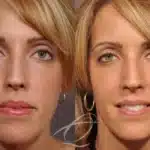
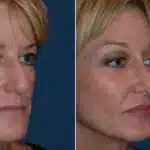
These cheek implant before and after pictures represent actual patients from Dr. Kopelman. They will help you to set realistic goals for your own surgical outcome. Click on a patient to learn more about their cheek implant procedure.
To achieve the best midface augmentation in Miami, Dr. Kopelman will thoroughly review your facial skin, soft tissues, and skeletal structure, then discuss your goals and expectations.
Implants vary in size, projection, and shape. The specific device selected is based on your individual anatomy, since the same implant produces very different results on different bone structures. Finding the right fit separates a natural outcome from an overdone one.
Candidacy is not determined by age alone. Younger patients with congenitally flat malar bones and older patients with age-related volume loss can both be appropriate, for different reasons.
Cheek contouring in Miami can be achieved surgically or non-surgically, and the right answer depends on how much correction you need and how long you want it to last.
Fillers are non-surgical, immediate, and reversible in most cases, but they require maintenance sessions and can migrate or look heavy when repeatedly overfilled in the same plane. Implants require surgery once and then remain stable.
Patients who have already had multiple filler rounds without lasting satisfaction are often the clearest implant candidates. Patients unsure about a permanent change sometimes start with filler as a preview.
Dr. Kopelman makes a small, concealed incision inside your mouth, allowing the implant to be slipped into position on the cheekbone. This intraoral approach leaves no visible external scar.
The implant conforms to the underlying bone, seating naturally and staying secure. The mouth incision is then closed with absorbable suture.
You will take oral antibiotics and use mouthwash for five days to protect the incision while it heals. The face will remain noticeably swollen for approximately one week.
Malar augmentation is frequently combined with other facial procedures during the same session, which can consolidate recovery into a single period rather than two.
| Factor | Facial Implant | Dermal Filler |
|---|---|---|
| Duration | Permanent | Temporary, repeat sessions required |
| Procedure type | Outpatient surgery with anesthesia | In-office injection |
| Downtime | About one week of visible swelling | Minimal, hours to a few days |
| Best suited to | Skeletal deficiency, significant volume loss | Mild to moderate soft tissue volume loss |
| Reversibility | Removable or exchangeable by surgery | Often dissolvable, depending on product |
| Long-term cost pattern | One-time | Recurring for as long as results are maintained |
Healing from midface augmentation is generally quicker than patients expect. The intraoral incision closes within 7 to 10 days, and most people return to non-strenuous work within that window.
Residual swelling typically lasts about three weeks, with the final contour becoming clear over the following months. Temporary numbness across the treated area may last up to three months as sensory nerves recover.
Soft foods and diligent oral rinsing are required during the first week. Contact sports and any activity that risks a blow to the face are restricted for a longer period.
Facial implant surgery is well established, but it is still surgery. Recognized risks include swelling, bruising, temporary numbness, infection, asymmetry, and the uncommon possibility of implant malposition requiring revision.
Proper placement over bone, with adequate pocket dissection, keeps a device stable long term. Implants are not routinely replaced on a schedule the way breast implants are; most patients keep them indefinitely.
The American Society of Plastic Surgeons and the American Academy of Ophthalmology both publish patient guidance on facial and periorbital surgical procedures for further independent reading.
Frequently asked questions
about Cheek Implants
A cheek implant can cost anywhere from $6500 to $8500. This includes the anesthesia required to be performed by an anesthesiologist.
You will heal from your cheek augmentation procedure quickly. The mouth incision will be completely healed within 7 to 10 days. Residual swelling may last in most cases for three weeks. Temporary numbness of the cheek, in most cases, may last up to three months.
Malar augmentation ranges from $6,500 to $8,500. This figure includes anesthesia, which an anesthesiologist administers rather than billing separately afterward.
Cost varies with whether one or both sides are treated, whether the procedure is combined with another surgery, and the complexity of the correction required. Facial implants are elective and are therefore not covered by medical insurance.
Non-surgical alternatives carry a lower single-session cost but recur indefinitely, which changes the comparison meaningfully over a five- or ten-year horizon.
| Treatment | Cost | Notes |
|---|---|---|
| Cheek (malar) implants | $6,500 to $8,500 | Includes anesthesia administered by an anesthesiologist |
| Chin implants | Quoted at consultation | Depends on implant selected and combined procedures |
| Jaw implants | Quoted at consultation | Depends on implant selected and combined procedures |
| Infraorbital implants | Quoted at consultation | Assessed separately during evaluation |
| Juvederm Voluma | $1,800 | Cheek and mid-face contouring, non-surgical |
| Restylane | $2,500 | Used for lips, cheeks, or under-eye depending on type |
| Sculptra | $2,500 per vial | Collagen-stimulating, multi-session |
Frequently asked questions
about Cheek Implants
A malar implant procedure costs between $6,500 and $8,500 at our practice. That price includes anesthesia performed by an anesthesiologist. We quote chin and jaw implant pricing at consultation, since it depends on the implant selected and whether it is combined with other procedures.
You will heal from midface augmentation quickly. The mouth incision is completely healed within 7 to 10 days. In most cases, residual swelling lasts about three weeks. Temporary numbness of the treated area may last up to three months.
Yes. Unlike injectable filler, an implant does not dissolve and does not require repeat treatment. You can remove or replace it if your goals change, though most patients never do.
No. The intraoral approach places the incision inside the mouth, so there is no external facial scar.
An infraorbital implant is placed along the bony rim beneath the eye to correct skeletal hollowing in that specific zone. It addresses a different problem than a malar implant and is assessed separately during your evaluation.
Frequently, yes. Combining structural augmentation with lifting procedures often produces a more balanced result than either alone, and it consolidates recovery into one period.
If you want a lasting structural change and have already cycled through filler without durable satisfaction, an implant is usually the better answer. If you want to preview a change or need only mild correction, filler is a reasonable starting point.
Skeletal maturity, generally reached around age 18, is the relevant threshold rather than a specific age. Patients in their twenties with naturally flat malar bones are common candidates.

To schedule a private consultation with Dr. Kopelman, please call the office or request an appointment online.
Lorem ipsum dolor sit amet, consectetur adipiscing elit. Ut elit tellus, luctus nec ullamcorper mattis, pulvinar dapibus leo.