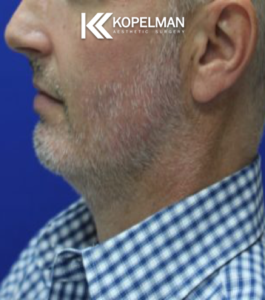
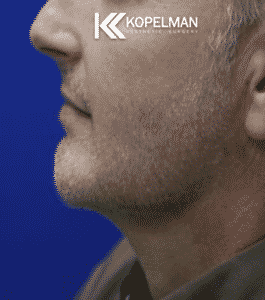
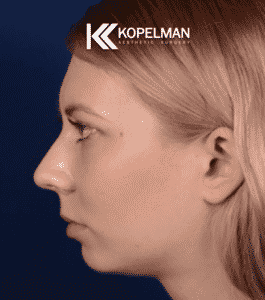
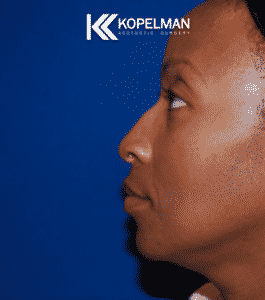
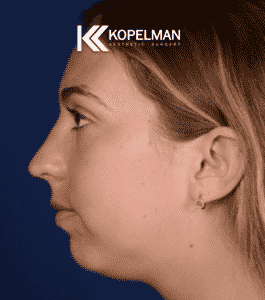
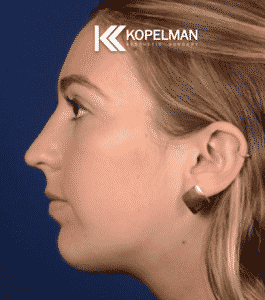
Chin augmentation in West Palm Beach is a surgical procedure that uses an implant to improve projection, lower-face balance, and facial profile. Patients most often consider it when their lower face appears small or recessed compared with the nose, jawline, or midface.
The procedure takes about one hour, is usually performed under IV sedation with local anesthesia, and most patients return to desk work within five to seven days. Results are permanent, though the implant can be removed or exchanged later if a patient’s goals change.
In some cases, a recessed profile can make the nose look more prominent, even when the nose itself is proportional. Adding structure to the lower face may improve the relationship between the jawline, neck, and midface. Surgeons commonly place the implant through a small incision below the jaw, though the exact approach depends on the surgeon’s plan and the patient’s anatomy.
For patients seeking a temporary, non-surgical option, hyaluronic acid fillers such as Juvéderm can add projection with little to no downtime. Injectables show an immediate change in contour, but results usually last months rather than years. Implants remain the long-lasting surgical option for structural enhancement.
The objective of the surgery is to restore facial balance and harmony in people with receding profiles relative to other features. The implant lengthens vertical frontal facial dimensions and improves horizontal projection. Alternatively, you can inject non-permanent hyaluronic facial fillers such as Juvederm.


“I have been eager for a long time to improve my profile. I always felt that I had a recession in my chin. Dr. Kopelman helped create the facial balance and symmetry I hoped for. I am super happy with my outcome and the projection of my chin, which now looks and feels natural. I’m excited when I look in the mirror, especially when I put on makeup to head out with friends. If you are looking for an honest plastic surgeon who will deliver the highest quality of work, Dr. Kopelman is your best bet.”
~ Rebecca Klein ~
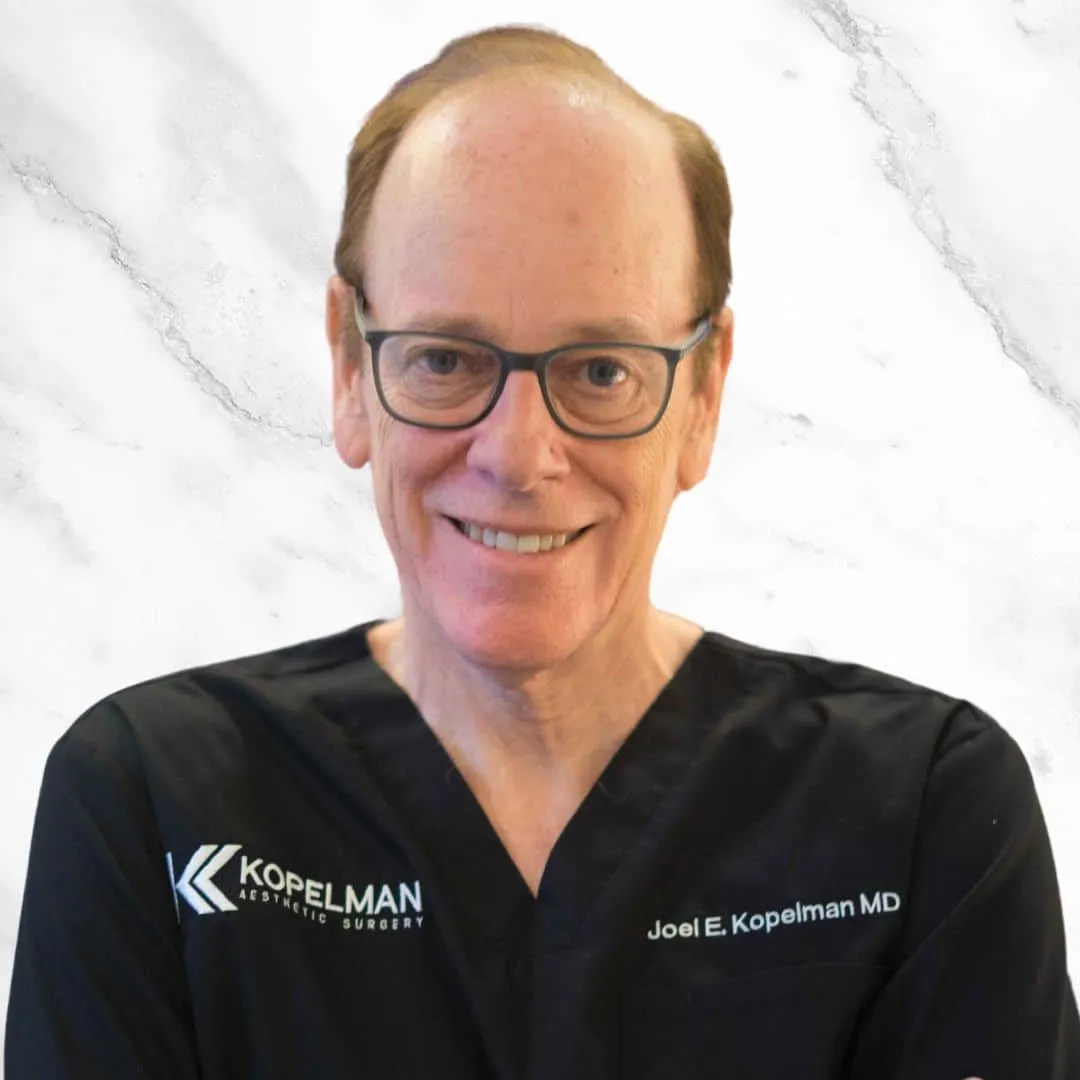
Dr. Joel E. Kopelman, MD, FACS, is a facial plastic and oculoplastic surgeon with over 35 years of experience in cosmetic rejuvenation of the face, neck, and eyes. He is a Fellow of the American College of Surgeons and a member of the American Society of Ophthalmic Plastic and Reconstructive Surgery (ASOPRS).
His oculoplastic training is directly relevant here, because implant position influences how the lower face reads against the eyes and midface in profile. Board certification matters when comparing surgeons; the American Society of Plastic Surgeons maintains a public verification tool for confirming a surgeon’s credentials.
To achieve the best chin augmentation in Palm Beach Gardens FL, Dr. Kopelman will thoroughly review your facial skin, soft tissues, and skeletal structure, then discuss your desires and expectations for surgery. He will determine whether you have a weak or receding profile by examining your upper and lower jaw.
That assessment determines the size and type of implant required for an optimal aesthetic result. Implants come in many shapes and sizes and are manufactured from both solid and semi-solid materials. Finding the right fit is critical to achieving natural-looking results.
Ideal Candidate
Benefits
Techniques
Chin augmentation will balance your frontal and profile facial proportions.
Dr. Joel Kopelman performs the surgery through a small incision along the natural crease under the jaw. Most patients receive IV sedation with local anesthesia rather than general anesthesia, which shortens recovery time on the day of surgery.
The implant is inserted through this incision and positioned along the jawline against the bone, where surrounding tissue holds it in place. The incision is closed with tiny sutures and is well camouflaged, so it becomes almost invisible as it heals.
Placement can also be performed intraorally through an incision inside the lower lip, leaving no external scar. The submental approach is often preferred because it gives direct visibility of the bone and avoids exposing the implant to bacteria inside the mouth. Dr. Kopelman selects the approach during your consultation.
Most implants are made from solid silicone, which is flexible, well tolerated by surrounding tissue, and straightforward to remove or exchange. Porous polyethylene is a second option; tissue grows into its surface, which improves stability but makes later removal more involved.
Sizing is not one number. Implants vary in projection, width, and whether they extend along the jaw toward the angles for a wider result. Dr. Kopelman photographs and measures the jawline preoperatively to match the implant to your anatomy rather than fitting a standard size.
| Detail | What to Expect |
|---|---|
| Procedure time | Approximately 1 hour when performed alone |
| Anesthesia | IV sedation with local anesthesia; general anesthesia for some combined cases |
| Incision options | Submental (beneath the jaw) or intraoral (inside the lower lip) |
| Implant materials | Solid silicone or porous polyethylene |
| Suture removal | Day 5, followed by steri-strips for three days |
| Time off work | Approximately 5 to 7 days |
| Exercise clearance | Typically 3 to 4 weeks |
| Longevity of results | Permanent; implant can be removed or exchanged |
Most patients are away from work for about five to seven days. Swelling and bruising are expected in the first several days and resolve steadily. Chewing may feel limited at first, and many patients prefer soft foods for the first two to three days.
A tight or stretched sensation across the lower face is normal and usually subsides within a week. Keep your head elevated, including while sleeping, to limit swelling. Avoid strenuous exercise and contact sports until Dr. Kopelman clears you, generally around three to four weeks.
Final results become apparent as residual swelling resolves over several weeks. The day-by-day timeline below reflects the typical postoperative course.
| Day | Wound Care | Swelling & Comfort |
|---|---|---|
| Day 1 | Remove the dressing as directed | Cold compresses; Tylenol every 4 to 6 hours while awake |
| Day 2 | Begin topical antibiotic cream to the incision four times daily | Swelling begins to subside; continue cold compresses |
| Day 3 | Continue antibiotic cream four times daily | Swelling and possible bruising still present; switch to warm compresses |
| Day 4 | Continue antibiotic cream four times daily | Swelling starting to resolve; less discomfort |
| Day 5 | Sutures removed; steri-strips applied and left in place three more days | Most patients comfortable without pain medication |
Pricing depends on implant type, whether the procedure is performed alone or combined with another surgery, and anesthesia requirements. Fees are quoted at consultation once the surgical plan is confirmed, so you receive an accurate figure rather than a range that may not apply to your case.
Related procedures frequently combined with lower-face enhancement have published ranges, listed in the table below for reference. Combining procedures in a single operative session typically costs less than staging them separately, because facility and anesthesia time are shared.
| Procedure | Cost | Notes |
|---|---|---|
| Chin augmentation with implant | Quoted at consultation | Depends on implant type and whether combined with another procedure |
| Consultation | $350 | Applied toward surgical planning |
| Juvederm Voluma (non-surgical option) | $1,800 | Cheek and mid-face contouring; temporary result |
| Restylane (non-surgical option) | $2,500 | Used depending on filler type and treatment area |
| Necklift (commonly combined) | $40,000 to $50,000 | Often staged with lower-face enhancement |
| Deep plane facelift (commonly combined) | $45,000 to $60,000 | Combining in one session shares facility and anesthesia time |
Pricing reflects current practice fees and is confirmed during consultation.
Frequently asked questions
about Chin Implants
Dr. Kopelman will photograph and measure the chin and jawline to select the ideal size implant that will harmoniously balance your profile and frontal dimensions. If a patient is not yet ready for chin augmentation surgery then Dr. Kopelman may recommend the temporary use of an injectable filler in the chin. Hyaluronic acid gels like Juvederm, Voluma, or Restylane Lyft are safe and natural non-surgical alternatives to chin implant surgery. These temporary injections can give a patient a realistic vision of what a more balanced facial profile may look like. This temporary measure can give a patient time to determine if they like the change in their profile before committing to a permanent surgical procedure.
A chin implant can be a stand-alone procedure or scheduled in conjunction with another surgery such as a nose shaping procedure, liposuction of the neck and jawline, and a facelift procedure.
Dr. Kopelman will photograph and measure the jawline to select the ideal implant size that harmoniously balances your profile and frontal dimensions. If a patient is not yet ready for surgery, he may recommend temporary injectable filler. Hyaluronic acid gels like Juvederm, Voluma, or Restylane Lyft are safe, natural non-surgical alternatives.
These temporary injections give a patient a realistic vision of what a more balanced facial profile may look like. This gives you time to decide whether you like the change in your profile before committing to a permanent surgical procedure.
Yes. It can be a stand-alone procedure or scheduled with another surgery, such as nose shaping, liposuction of the neck and jawline, or a facelift. Combining procedures is common, since profile balance depends on the relationship among the nose, jaw, and neck.
Most cases are performed under IV sedation combined with local anesthesia. Some patients undergoing combined procedures may require general anesthesia. Dr. Kopelman confirms the plan with you before surgery.
Silicone implants are designed to be permanent, but they can be removed or exchanged if your goals change or if you are unsatisfied with the projection. Removal is a shorter procedure than the original placement.
The submental incision sits in the natural crease beneath the jaw, where it is not visible in conversation or in photographs once healed. Intraoral placement leaves no external scar at all.
Injectables add volume temporarily and are reversible within months, which makes them useful for previewing a change. An implant provides fixed structural projection that does not need repeat treatment. Patients often start with filler and move to surgery once they confirm they like the result.
As with any surgical procedure, risks include infection, bleeding, temporary numbness of the lower lip, asymmetry, and implant shifting. The literature describes bone resorption beneath the implant, which is one reason implant selection and precise positioning matter. MedlinePlus provides general information about facial procedures.

To schedule a private consultation with Dr. Kopelman, please call the office or request an appointment online.
Lorem ipsum dolor sit amet, consectetur adipiscing elit. Ut elit tellus, luctus nec ullamcorper mattis, pulvinar dapibus leo.