Sculptra is an FDA-approved collagen biostimulator made of poly-L-lactic acid (PLLA). Unlike traditional facial fillers, Sculptra is not a filler in the conventional sense; rather than adding volume directly, it stimulates your body to rebuild its own collagen over time. This makes Sculptra an ideal option for patients who have lost facial volume due to descending fat pads and soft-tissue atrophy.
One of the most common questions patients ask is where Sculptra should be injected. It is especially effective in areas with broad, shallow volume loss, including the cheeks, temples, chin, jawline, and décolletage. By restoring collagen in these regions, Sculptra corrects hollow cheeks, sunken temples, and wrinkled chest skin while also softening facial wrinkles and fine lines.
Restylane and Juvederm are hyaluronic acid (HA) gels that work well for targeted augmentation in specific facial areas. However, these HA fillers are cohesive and viscous, so they cannot be spread evenly over broad areas like the cheeks, temples, or chest without appearing lumpy. Sculptra is diluted with sterile water before injection, allowing it to be distributed smoothly across a large surface area. Rather than producing an instant change, the PLLA microparticles trigger a gradual collagen-rebuilding process. Most patients begin to notice early improvement around four to six weeks, with full results developing over three to six months and lasting up to two years or more.


These Sculptra before-and-after pictures represent actual patients treated by Dr. Kopelman. Each set of images shows the gradual, natural-looking improvement that a collagen biostimulator produces over multiple sessions. Click on a patient to learn more about their treatment.
“Dr. Kopelman is the best!! He is extremely genuine and has great bedside manner. His fine attention to detail and his zealous to be conservative with cosmetic treatments has given me tremendous trust to continue to use him as my plastic surgeon.”
~ Sara Greenberg ~
Patients searching for Sculptra near me in the New York area trust Dr. Kopelman for his specialized understanding of facial anatomy. As a board-certified facial plastic and oculoplastic surgeon, Dr. Kopelman brings over 35 years of experience performing both surgical and non-surgical facial procedures. His dual fellowship training gives him in-depth knowledge of the anatomical structures beneath the skin, which is essential for precisely placing Sculptra where collagen loss has occurred.
During your consultation, Dr. Kopelman will review your medical history and evaluate your areas of volume loss to determine whether Sculptra, dermal fillers, or another procedure is the best fit for your goals. In addition to the New York City office on Park Avenue, Dr. Kopelman sees patients at his New Jersey location in Paramus and his Palm Beach, Florida practice, making it convenient to schedule treatment across the tri-state area and beyond.
Ideal Sculptra Candidate.
Sculptra Benefits
Sculptra is the ideal injectable for patients who have hollowing of their cheeks and temples.
Dr. Kopelman commonly recommends a series of one to three treatment sessions, spaced about four to six weeks apart. The number of sessions and vials used per session depend on the degree of volume loss in each patient. During each appointment, the treatment area is cleansed, and a topical anesthetic or local numbing agent is applied to minimize discomfort.
Because Sculptra works by triggering your body’s own collagen response, results are not immediate. The PLLA particles create a framework that your cells gradually replace with new collagen over the weeks following injection, with most patients noticing visible improvement between four and eight weeks after their first session.
Common Sculptra side effects after treatment include mild swelling, tenderness, and occasional bruising at the injection sites. These effects are temporary and typically resolve within 24 to 48 hours. Dr. Kopelman will instruct you to massage the treated areas for 5 minutes, 5 times a day, for 5 days after each session to ensure even distribution of the product beneath the skin.
Frequently asked questions
about Sculptra
Sculptra is not a traditional dermal filler like Juvederm or Restylane. While hyaluronic acid fillers add volume instantly by filling space beneath the skin, Sculptra is a collagen biostimulator that works gradually. Immediately following treatment, you may notice some fullness due to the water used to dilute the product, but this initial swelling subsides within a day or two.
True improvement develops over the following weeks and months as your body produces new collagen in the treated areas. This also means results are not reversible with an enzyme the way hyaluronic acid fillers are, so choosing an experienced injector is important.
For most patients, the collagen produced by Sculptra maintains its improvement for approximately two years, and in some cases longer. Because the results come from your body’s own collagen rather than an injected gel, the volume does not disappear suddenly. Instead, it diminishes gradually over time as part of the normal aging process. Periodic maintenance sessions can help extend the results.
The key difference is in how each product works. Hyaluronic acid fillers such as Juvederm and Restylane are gel-based injectables that add volume on contact and can be dissolved with an enzyme called hyaluronidase if needed. They are ideal for targeted areas like the lips or under-eye hollows.
Patients also frequently ask about Sculptra vs Radiesse, another popular option. Radiesse is made of calcium hydroxylapatite (CaHA) microspheres suspended in a gel carrier. It provides some immediate volume while also stimulating collagen, but its gel consistency makes it better suited to specific facial contours, such as the cheeks and jawline, rather than to broad surface areas.
Sculptra, by contrast, is mixed with sterile water and injected as a thin suspension that spreads evenly across larger zones such as the temples, mid-face, chin, and chest. It produces no instant volume; instead, the PLLA microparticles stimulate a collagen-rebuilding process that unfolds over several months. This makes Sculptra uniquely suited for patients with widespread, shallow volume loss who want subtle, progressive improvement.
The number of vials required varies based on the extent of volume loss and the areas being treated. As a general guideline, most patients receive two to four vials per session across one to three treatment sessions spaced four to six weeks apart. Patients with more significant volume loss, or those treating multiple areas such as the cheeks, temples, and chin together, may need additional vials. Dr. Kopelman will evaluate your facial structure during your consultation and recommend a personalized treatment plan based on your specific goals.
Sculptra has been FDA-approved for cosmetic use since 2009 and has a well-established safety profile when administered by an experienced injector. The most common side effects include temporary swelling, bruising, and tenderness at the injection sites. These typically resolve within a few days.
Less common complications include the formation of small nodules beneath the skin. This risk is higher if the product is not properly diluted, injected too superficially, or placed in areas with significant muscle movement, such as around the mouth. Rarely, some patients may experience a sensitivity reaction to PLLA.
Dr. Kopelman minimizes these risks through precise dilution protocols, careful injection depth, and post-treatment massage instructions. During your consultation, he will review your full medical history to confirm that Sculptra is appropriate for you.
At Dr. Kopelman’s New York City practice, Sculptra is priced at $2,500 per vial. As outlined above, most patients need between two and four vials per session, so a full treatment plan typically involves four to twelve vials in total. Factors that influence the final cost include the severity of volume loss, the number of areas being treated, and your individual collagen response.
Because Sculptra is a collagen stimulator that builds results over multiple sessions, many patients find that the per-year cost compares favorably to fillers that require touch-ups every six to twelve months. During your consultation, Dr. Kopelman’s team will walk you through the recommended number of vials and sessions so you have a clear cost estimate before starting treatment. Financing options are available to help make treatment accessible.

Frequently asked questions
about Sculptra
Immediately following treatment with Sculptra you will experience some swelling in the areas that were treated. After a day or so the swelling will subside and facial volume will be restored gradually over several weeks to months. Therefore, Sculptra is not a true filler like Restylane or Juvederm because Sculptra stimulates the facial cells to produce more collagen compared with hyaluronic gel found in Restylane or Juvederm. Many people consider this gradual improvement as a positive feature of this product.
The improvement from Sculptra is long lasting (around two years) in most patients.
Sculptra is used to add volume to the cheeks, temples and aged chest skin. This is possible because Sculptra is mixed with water and can be massaged smoothly over a large area compared with thicker more viscous hyaluronic fillers like Juvederm or Restylane.
Sometimes it is not necessary to have a more extensive “full” facelift because most of your facial cosmetic concerns revolve around loose neck skin, sagging neck muscles and bulging fat. Many patients do not show a significant loss of mid-facial fullness or the descent of upper facial soft tissue. Therefore, a more limited procedure, a limited neck lift, is a good alternative to having a traditional full facelift. Neck lifts can be performed with shorter incisions which can restore smooth contours to your neck. On the other hand, a “full” facelift , a more extensive procedure, is the ideal treatment option for patients with moderate to severe signs of aging including jowls,extensive muscle and skin laxity, and mid-facial volume loss. At the time of your initial consultation Dr. Kopelman will review your unique characteristics and concerns. You will have an opportunity to discuss your goals and expectations and ask any relevant questions you may have. Dr. Kopelman will determine if you are an ideal candidate for an isolated neck lift or for a traditional facelift.
Yes, if Sculptra is not reconstituted properly or injected around the mouth or injected too superficially then nodules can appear because the PLLA may become concentrated from muscle contractions. Rarely, some patients are allergic to the PLLA.
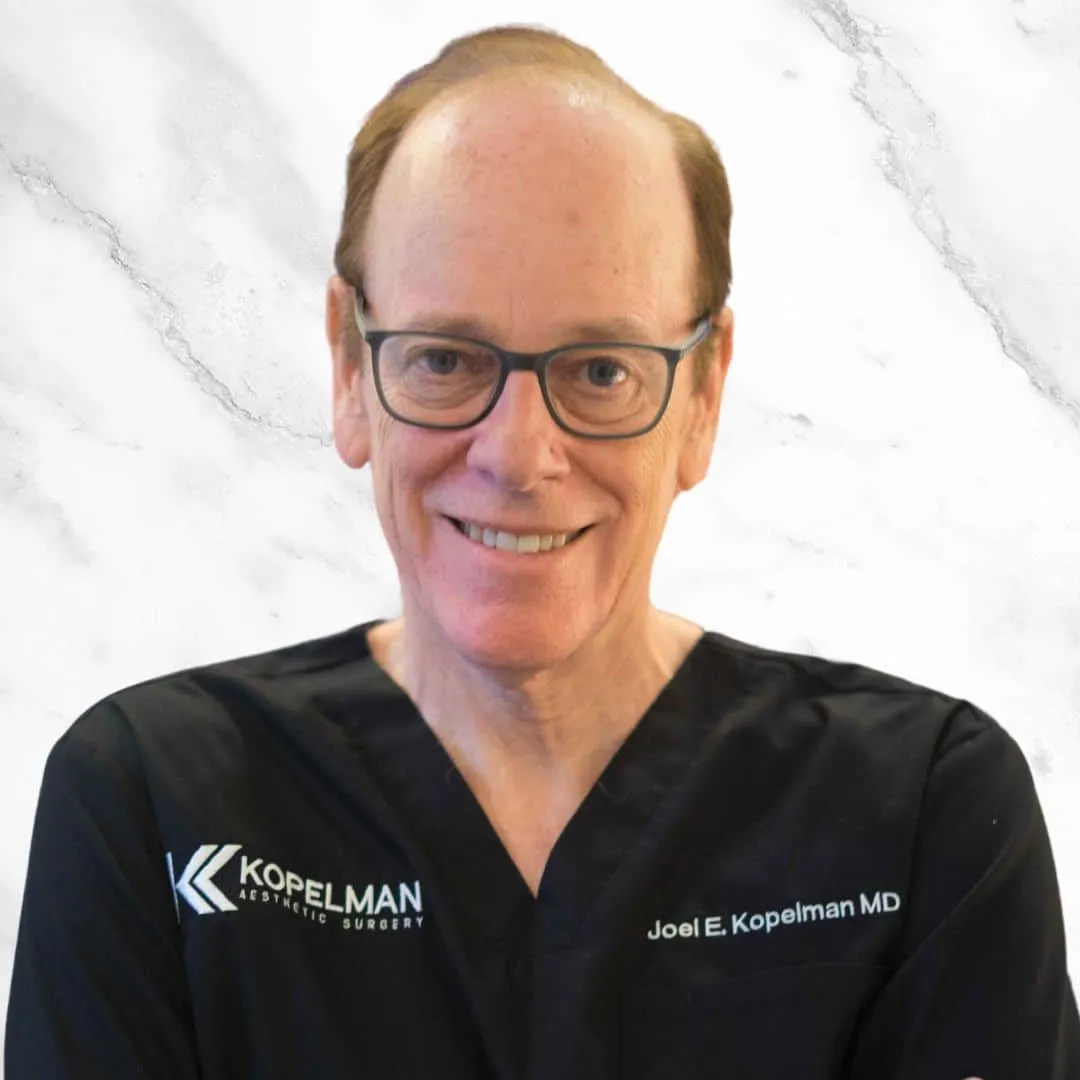
Dr. Joel E. Kopelman is a board-certified facial plastic and oculoplastic surgeon with over 35 years of experience in cosmetic rejuvenation of the face, neck, and eyes. A Fellow of the American College of Surgeons (FACS) and a member of the American Academy of Facial Plastic and Reconstructive Surgery (AAFPRS), Dr. Kopelman is known for his meticulous approach and his commitment to outcomes that look both natural and refined.
Dr. Kopelman’s dedication to patient care extends beyond technical skill. His warm, compassionate approach gives patients a sense of comfort and confidence throughout their treatment journey. Supported by a team of experienced professionals, he continually strives to exceed patient expectations and deliver lasting satisfaction.
Page Updated on 07/09/2026 by Dr. Joel Kopelman (Facial Plastic Surgeon) of Kopelman Aesthetic Surgery.
Schedule a Consultation
For Sculptra
Ready to book a Sculptra appointment? Contact our office to schedule a private consultation with Dr. Kopelman.
Lorem ipsum dolor sit amet, consectetur adipiscing elit. Ut elit tellus, luctus nec ullamcorper mattis, pulvinar dapibus leo.