Asian Eyelid Surgery Before & After: Double Eyelid Blepharoplasty

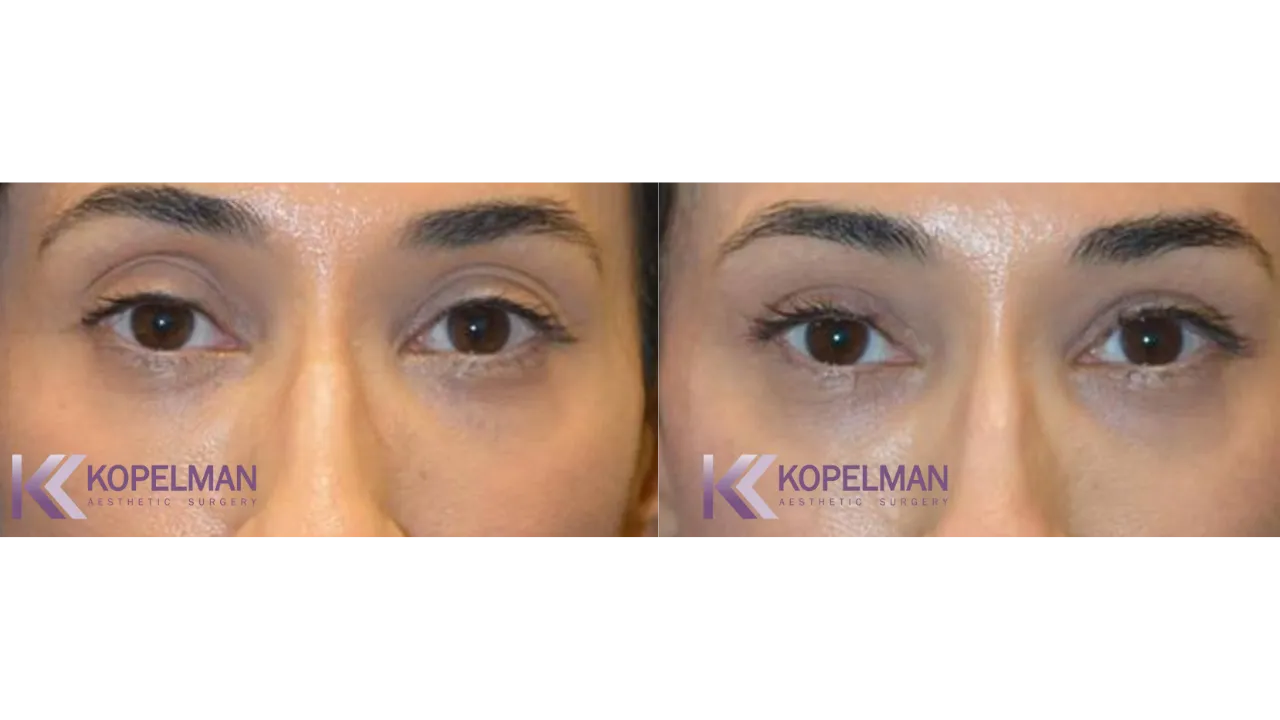
Below are before-and-after photos of Dr. Kopelman’s actual patients, shared with their permission. Results span a range of ages, concerns, and techniques, including crease creation, ptosis correction, asymmetry correction, and combined upper- and lower-face procedures.

Blepharoplasty Before and After: Subtle Balanced Results for Asian Eyes

For most patients, the change achieved through this procedure is subtle but meaningful. A well-placed crease improves eye contour, openness, and overall facial balance without altering ethnic identity.

In before-and-after comparisons of Asian eyelid cases, the shift from a puffy or tired appearance to a brighter, more defined eye is visible while still looking entirely natural.

When treating bilateral Asian eyelid asymmetry, improved symmetry is the primary functional outcome, while a natural shape and the preservation of ethnic features remain the aesthetic standard.
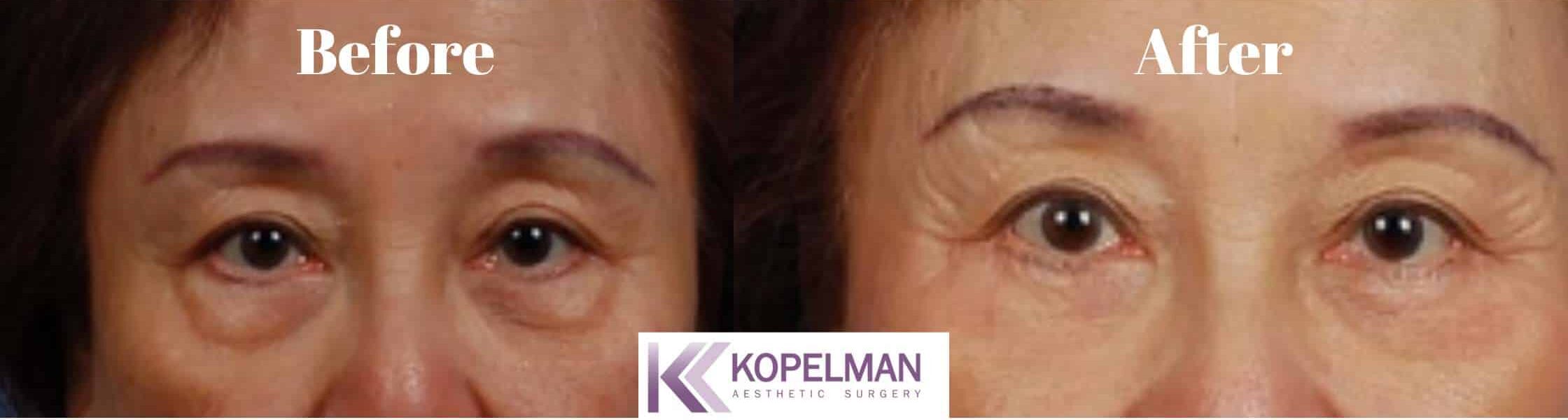
asian eyelids surgery before and after _ female patient 3

Case 2 — Female patient, asymmetric folds

Bilateral customized Asian blepharoplasty with crease formation to correct uneven upper eyelid folds. Photographed at 3 months post-op. Improved symmetry with no visible scarring.

Korean Eye Surgery Before and After: Precision and Harmony

Many patients use Korean eye surgery outcomes as a reference point when evaluating before-and-after results. These patients typically seek more visible creases or subtly lifted corners without dramatic change. Dr. Kopelman focuses on precision, symmetry, and harmony, customizing crease height and contour to complement each patient’s bone structure and facial proportions. The result should look like a better version of the patient, not a different person.

Technique: Why Asian Blepharoplasty Is Different

Asian eyelids differ anatomically from non-Asian eyelids in three key ways: they typically lack a defined supratarsal crease, they carry more preaponeurotic fat, and the levator muscle attaches at a lower position. Each of these factors affects how the surgery is planned and performed.

A one-size-fits-all approach does not work for this procedure. Dr. Kopelman develops an individualized surgical plan for every patient based on their specific anatomy, aesthetic goals, and skin characteristics.

  • Incisional method: Provides more permanent results and is best suited for patients with excess skin, fat, or muscle. This approach offers greater control over crease height and contour.
  • Non-incisional (suture) method: Creates a crease without cutting the skin, using sutures placed through small punctures. Ideal for younger patients with good skin elasticity who want faster recovery and minimal risk of visible scarring.

Many patients also combine blepharoplasty with ptosis repair when one lid sits lower due to weak levator function, such as a left eye appearing lower than the right. Performing both procedures together achieves the most balanced functional and aesthetic result.

Asian Blepharoplasty Before and After: Common Improvements Seen

In before-and-after comparisons across Asian blepharoplasty cases, the most consistent changes include:

  • A smoother upper lid with a defined crease
  • Reduction of under-eye bags and upper lid puffiness
  • Improved symmetry between the eyes
  • A more alert, rested appearance that still looks like the patient

When ptosis correction is performed simultaneously, the functional benefit, such as reduced lid droop obstructing the visual field, is also documented alongside the cosmetic result.

Male Asian Blepharoplasty: Natural Enhancement

More men are pursuing crease creation and upper lid refinement for subtle improvements. The approach for male patients is tailored to preserve a masculine lid contour while achieving a more alert, youthful eye.

In before-and-after cases for men, the goal is rarely a high or prominent crease. A lower, more tapered fold that suits the male facial structure is typically preferred, and results should be undetectable as surgical.

Can You Tell If Someone Had This Procedure?

With expert technique, the answer is usually no. Meticulous incisional and non-incisional methods, when performed with attention to crease height, contour, and symmetry, produce results that are difficult to identify as surgical unless the patient has a deliberately deep or high crease.

An experienced oculoplastic surgeon understands where the line between natural and overdone lies. That calibration is the most important skill in this procedure.

Why Do Patients Seek This Procedure?

Motivations vary from individual to individual and should not be reduced to a single cultural explanation. Common reasons include:

Aesthetic preference for a more defined crease and a brighter eye appearance
Desire to correct congenital ptosis or pre-existing asymmetry
Improving facial harmony and perceived approachability
Personal confidence, independent of cultural or social pressure

The procedure is not about changing ethnic features. It is about refinement. Many patients are explicit about wanting to look like themselves, with better-defined eyes.

How Long Do Results Last?

Longevity depends on which technique is used. With the incisional method, results are typically permanent. Skin aging over decades may cause some evolution of the fold, but the surgically created crease attachment remains.

With the non-incisional suture method, the crease is less permanent. Some patients require revision after several years as sutures loosen or the lid changes with age.

When crease formation is combined with ptosis repair, the results often remain stable for decades because the levator muscle position is structurally corrected rather than merely cosmetically adjusted.

How Painful Is the Procedure?

Most patients report only mild discomfort. Surgery is performed under local anesthesia, making the procedure itself painless. Post-operative symptoms include swelling, tightness, and mild bruising, but significant pain is uncommon.

Dr. Kopelman provides thorough aftercare instructions to support a smooth recovery and minimize discomfort during healing.

Healing Timeline: What to Expect After Asian Eyelid Surgery

The recovery from Asian upper blepharoplasty follows a predictable pattern. Patients undergoing combined ptosis repair may experience a slightly longer stabilization period as the levator muscle settles into its new position.


Healing Timeline After Asian Eyelid Surgery
Phase What Happens
Days 1 to 3 Swelling and bruising peak; lids may feel tight
Days 4 to 7 Sutures removed; swelling begins resolving
Weeks 2 to 4 Contours settle; bruising disappears
Months 2 to 6 Final crease shape becomes visible; healing is complete

Note to developer: format the four timeline entries above as an HTML table with two columns, one for Phase and one for What Happens. This makes it eligible to appear as a featured snippet in search results.

Patients should expect the crease to look higher or deeper than the final result during early healing. The fold softens and settles over weeks.

Cost of Asian Eyelid Surgery in the US

The total cost depends on the complexity of the procedure, the techniques required, and the surgeon’s level of specialization. Combining crease formation with ptosis repair or lower blepharoplasty increases the overall fee.

Estimated Cost of Asian Eyelid Surgery
Procedure Estimated Cost
Standard crease formation (upper lids) $3,000 to $6,000
Combined with ptosis repair $5,000 to $8,000

Costs include pre-operative consultations, surgical fees, anesthesia, and post-operative care. Financing options may be available. Patients are encouraged to confirm the full fee breakdown during their consultation.

About Dr. Kopelman

Dr. Kopelman is a board-certified oculoplastic surgeon with decades of experience in Asian upper blepharoplasty and crease formation. He completed fellowships at UCLA, Moorfields Eye Hospital, London, and the Armed Forces Institute of Pathology, and is a Fellow of the American College of Surgeons (FACS), a member of the American Society of Ophthalmic Plastic and Reconstructive Surgery (ASOPRS), and affiliated with the American Academy of Ophthalmology (AAO) and the American Academy of Facial Plastic and Reconstructive Surgery (AAFPRS).

His focus is on understanding the distinct anatomy of Asian eyelids and translating that understanding into individually calibrated, not templated, results. Both the incisional and non-incisional techniques are offered, and the choice is made based on each patient’s anatomy, goals, and recovery preferences.

Patients seeking asian eyelid surgery in NYC, double eyelid surgery in NYC, or asian double eyelid surgery from a specialist with oculoplastic expertise will find detailed case reviews available during private consultations.

What sets Dr. Kopelman apart is his ability to create a natural-looking upper eyelid crease that complements the patient’s facial features and ensures long-term satisfaction. His approach combines artistic precision with medical expertise, balancing aesthetics with function. His work has been featured in peer-reviewed oculoplastic surgery literature and media coverage spanning his 35-year career.

Frequently Asked Questions: Asian Eyelid Surgery Before and After

The incisional method involves making a small cut along the upper eyelid to remove excess skin, fat, or muscle before creating the crease. It produces permanent results and gives the surgeon more control over the crease height and shape.

The non-incisional method uses sutures placed through tiny punctures to fold the eyelid into a crease without cutting. It is better suited to younger patients with thinner lids and good skin elasticity, and it allows for faster recovery, but the results may loosen over time.

Most patients see their final crease shape between two and six months after surgery. In the first few weeks, the crease will look higher or more defined than it will in the finished result. The fold softens gradually as swelling resolves and the tissues settle. Patients who also underwent ptosis repair may take slightly longer for the final lid position to stabilize.

Yes. For patients without a history of prior eyelid surgery, the procedure carries a straightforward risk profile when performed by a board-certified oculoplastic surgeon.

The main considerations are choosing the right technique for the patient’s anatomy and ensuring realistic expectations about crease height and symmetry. During consultation, Dr. Kopelman evaluates each patient’s specific anatomy, skin quality, and goals before recommending a surgical approach.

Yes, and asymmetry correction is one of the most common reasons patients seek this procedure. When one lid has a visible crease and the other does not, or when the crease heights differ significantly, bilateral Asian blepharoplasty can bring both lids into better balance.

In cases where the asymmetry involves a drooping lid caused by weak levator muscle function, ptosis repair is performed at the same time to achieve even lid height alongside crease creation.

When the crease height and contour are properly matched to the patient’s facial anatomy, the results are consistently described as natural by patients and by people who know them.

The goal is not to eliminate ethnic features but to refine the eyelid contour in a way that suits the individual. Results that look unnatural are typically the product of a crease set too high, too deep, or without regard for the patient’s existing anatomy.

Schedule a Consultation

For Asian Eyelift

To schedule a private consultation with Dr. Kopelman, please call the office or request an appointment online. 

Add Your Heading Text Here

Lorem ipsum dolor sit amet, consectetur adipiscing elit. Ut elit tellus, luctus nec ullamcorper mattis, pulvinar dapibus leo.